+41 62 918 41 11

Mineral casting and the geometry of the products

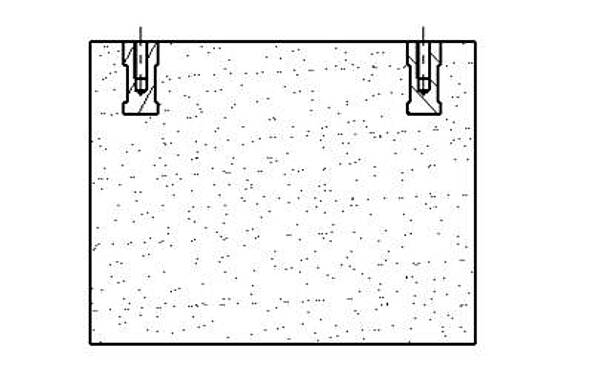
A significant advantage of mineral casting is that the most geometrically complicated structures/ bases can be manufactured without the need for further processes. This necessitates an accurate tool (mould), which can usually be amortized over a short time period. Threaded inserts, mounting plates, spindle attachments etc. are pre-cast as moulded-in parts and provided for in the design phase of the mould, thus removing the need for any complex, cost-intensive finishing or machining. This of course, means shorter turn-around times, which plays an increasing role in modern times.
Bonding agent

The bonding agent, also called a matrix, consists of resin and after the recipe is agreed - the application- specific fillers are added. Epoxy resin is used, as opposed to Methacrylate resin, and polyester resins exhibit less contraction (volume shrinking) and an improved processing time. When poured the bonding agent also acts as a lubricant between the elements of the filler, thus improving the flow characteristics. There can be no chemical reaction between the filler and the bonding agent. Cast parts containing epoxy resins as bonding agents are not suitable for operating temperatures of over 80°C.

Advantages of epoxy resins

  • Low viscosity gives good flow characteristics
  • Guarantee that the filler used is well lubricated
  • Long gel time
  • Slow hardening by precipitation, combined with low exotherms
  • Good mechanical characteristics (tension, compression, bending, elastic modulus, thermal expansion)
  • Good chemical characteristics, i.e. resistant to aggressive liquids
  • Good long-term behavior
  • Epoxy resins are certified for the food industry


SCHNEEBERGER mineral casting

New: Our techcon® - a specially developed cement mixture for "selected applications" and developed as a cost-effective alternative to mineral casting.

Information: at moment not available for the Asian market

Since its introduction to the market (30 years ago) as a modern material, mineral casting is has presented an important alternative to conventional grey cast iron or steel construction and today, it is the superior technology for a vast number of applications.

From design and casting to the high-precision finishing, the entire process is subject to stringent quality assurance measures

Presence: SCHNEEBERGER Mineralgusstechnik operates in the EU (Cheb in the Czech Republic) and in China.

In both the European and Asian markets, we operate our own local production facilities and have sales offices in all major industrial countries.

More information:
Link to press release

New: Mineral castings direct to your assembly line

More value-added from SCHNEEBERGER Mineralgusstechnik! We also perform complex assembly work on the mineral castings we produce. Not only will we assemble the parts, our service includes the complete procurement process as well as the entire logistic and quality management functions. This enables SCHNEEBERGER Mineralgusstechnik to deliver greater added value to our customers.

Customer benefits: Significantly shorter lead times and clear cost benefits since we assume the responsibility for the entire sub-assembly.

Do not hesitate to contact us at any time for a non-binding consultation.

Link to contact form

Design concept

Wall thickness

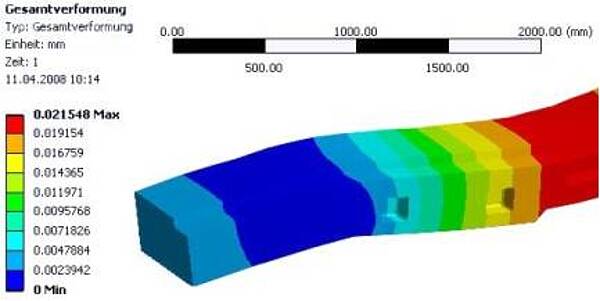
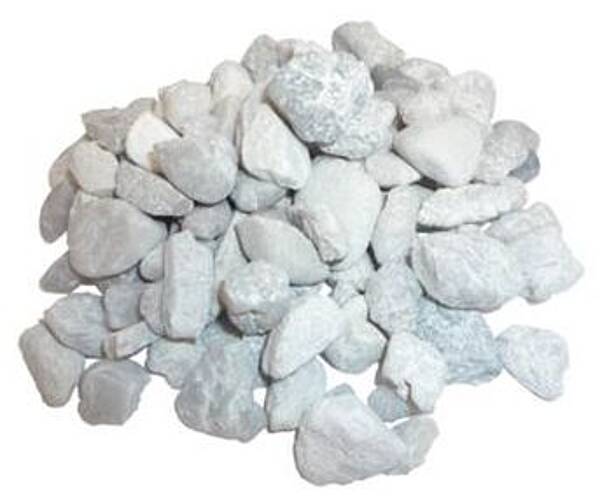
The castings and wall thickness of mineral casting components must in general be at least five times greater than the maximum pebble diameters. With a typical maximum pebble diameter of 16 mm, the castings and wall thickness must therefore be at least 80 mm. Due to the low residual stresses varying wall thicknesses and sudden changes from thin to thick wall thicknesses can be achieved without a problem in a mineral casting component. Good rigidity values are attainable with the appropriate selection of cross sections and by taking into account the greatly varying permissible tensile and compressive stresses.

It is also possible to work with thinner wall thicknesses in the non-load-bearing parts of the construction. Here mineral casting mixtures are used that have a smaller maximum pebble diameter. The first casting of a multi-level casting procedure, where first the finer mixture is poured followed by the coarser composition, is called pre-casting.

Casting

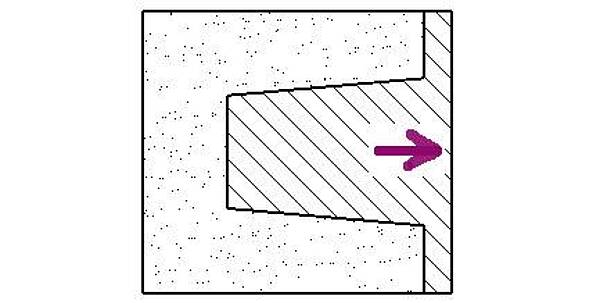
Mould release slopes are used to release the casting blank, similar to the method used for gray cast iron. The recommendation to use an approx. 5° slope for cast parts made from gray cast iron is often also used for mineral casting. However, in practice smaller casting angles are quite sufficient for mineral casting.

Ventilation

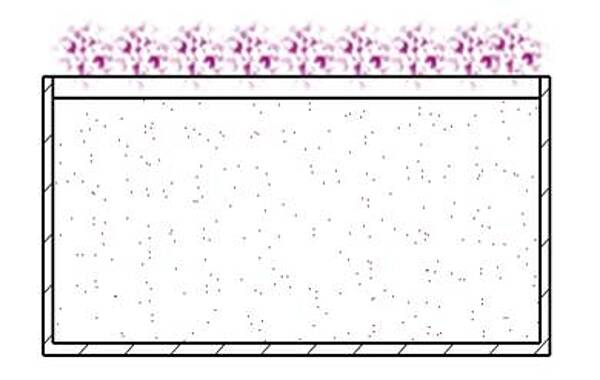
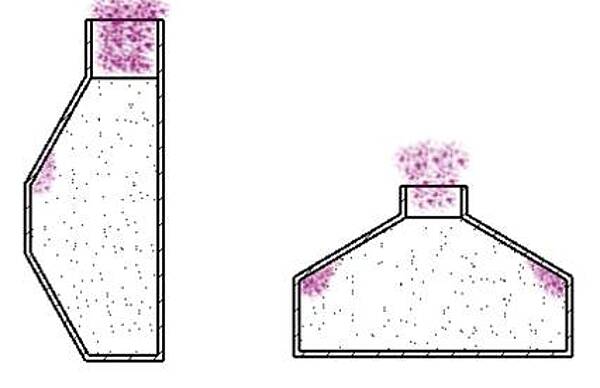
Whilst the mineral casting mixture is produced air enters the compound simply through the mixing process itself. Besides this, air is also entrapped inside the mould and the compound during the casting procedure. To ensure that the finished component will not exhibit any shrinkage cavities later on, after pouring in the compound the mould is vibrated until practically no more trapped air bubbles up.

For this purpose there must be a suitable venting of the mould. This can be done, if mould segments and casting parts are arranged in such a way that they do not obstruct either the incoming mineral casting or the outflowing air. Bubbles can form particularly on horizontal surfaces, which the mineral casting rises against from below. Such surfaces are to be avoided if possible or they are to have a  relatively large angle, in order to make it possible for air to escape.

Loading capacity

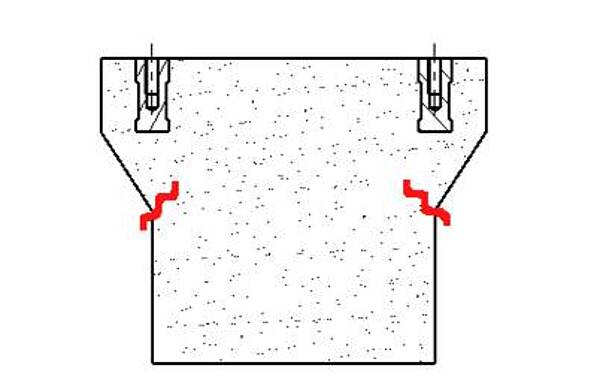
During the construction of mineral casting components it is essential to bear the material's special characteristics in mind. Cast components can, for example, withstand substantially higher compressive and tensile forces. When anchoring cast parts it is to be ensured that they are set at a sufficient distance from the component's edges, so that they do not break off. For the minimum distance to the edges use the corresponding table of the cast part. If screw connections are to be used within the mineral casting component, it is to be ensured that the cast material can withstand the loads created by the forces acting on the thread. If there is the risk of it shearing off, it must be treated with suitable metal threaded bushes, which are cast in the necessary places. The notch effect is clearly reduced and the redirection of the force is improved by rounding and/or chamfering the connectors between the component units. Likewise suitable measures must be taken for the necessary transport to the customer. So for very large components lifting points, which make it possible to load them safely with cranes and similar lifting equipment, must be designed into the structure. To prevent any transport damages, rails can also be inserted on the underside for transport by fork-lift trucks.

Structure of the basic geometry

The mould is made from wood, steel, aluminum, PVC, silicone, polyamide or a combination of these materials. The main criteria for the selection of the suitable form material are:

  •  the estimated number of castings to be produced by a mould,
  • the required accuracy and surface quality of the mineral casting components,
  • size, weight,
  • planned variants in the casting,
  • costs and time

The design of the mould, the calculation of the mould and the construction of the mould all run parallel to the construction of the part. The design criteria of the mould must be considered in order to ensure the geometrical accuracy and high static and dynamic rigidity:

  • The design of the main functional surfaces the mold are critical , in order to ensure the accuracy.
  • Moulds are mostly made from plates. Basic geometry is design from simple elements.

Integration of mechanical components

Threaded inserts, steel plates, transportation anchors, cables and trunking, s and hollow cells can be cast directly in the mineral casting component as it is a cold casting process.

In order to ensure that it is in optimal working order later on, all mechanical components must be fastened securely as their position can no longer be corrected later on and substantial lift forces develop during the casting procedure, which could change the position if the fastening is not secure enough. It must be ensured when the component is being sesigned and more importantly later with the construction of the mould, that this insert does not obstruct the flow of material or the venting of the mold.

If the threaded holes are too close to the edge or if the mineral casting component has hole pattern with mating holes, special cast parts are moulded in. These special cast parts (mouldings, plates) are anchored to the mineral casting component with hexagonal screws.

Operational surfaces

As described in the chapter on accuracy, a maximum accuracy of approximately +/- 0.1 mm/m can be attained with good moulds. Many components however, have a mating surface for other parts, which clearly require a greater accuracy, for example for the attachment of linear guide systems, sliding or mounting surfaces. It is therefore imperative to integrate these functional surfaces in order to attain the specified tolerances. Today SCHNEEBERGER essentially uses four procedures as below, in order to create the necessary surfaces:

  • Machining of mineral casting - with this procedure the mineral casting is poured with an excess and afterwards machined to the exact size by milling or grinding.
  • Machining of cast parts - with this procedure, metal parts, such as steel or cast iron plates, are cast into the mineral casting and machined after the casting has hardened.
  • Replication - with this procedure the mineral casting is poured approximate 2 mm undersize. After removing the mould there is a second casting stage where very fine material is cast with a precise setting jig.
  • Subsequent casting in of metal parts - With this procedure high-precision cast parts are precisely cast in after removal of the mould using positioning gauges.


Transport and set-up

Transport

The mineral casting components must be securely fixed during transport. A crane, fork-lift truck and truck are used for transport. In addition suitable anchors and rails are to be provided.

Set-up

In principle similar rules for bases made from steel or gray cast iron also apply to the set-up of mineral casting racks. Special foundations are very important particularly with large machines because, in their typical suitable construction as an engine foundation with 70-90% of the total mass of a machine, they guarantee a high overall torsional stiffness with the high inertial mass and they can attain the necessary accuracy thanks to the smooth running of the machine.

A correspondingly substantial dimensioning of the machine foundation is of great importance particularly with extremely heavy component parts and/or a correspondingly large workforce or with sudden impact loads, because otherwise it results inevitably in the partial sinking of the machine and so the geometrical accuracies typical of today are no longer attained over the entire working space. Machines with a three-point set-up are an exception to this rule, because their accuracy does not depend on the foundation.

SCHNEEBERGER E-NEWS
Exclusive advantages for newsletter subscribers:
  • New products and innovations
  • Stay up to date on market trends and developments
  • Information on trade fairs and events
SCHNEEBERGER Newsletter SCHNEEBERGER Newsletter