MINISCALE PLUS ensures precise and reliable distance measurement. Integrated into MINIRAIL profile rail guides, it reduces the Abbe error through direct in-process measurement. Designed for high speeds and accelerations, it delivers robust performance for demanding high-tech applications.
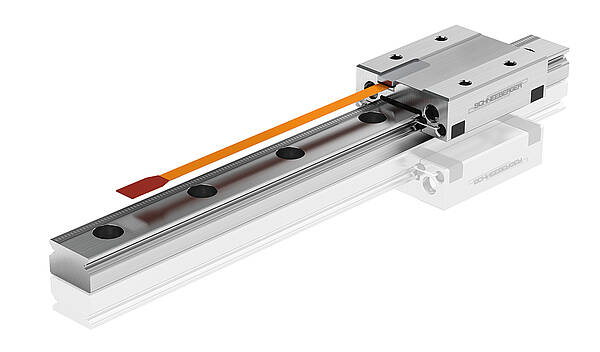
MINISCALE PLUS – Miniature guideway with integrated distance measuring system
MINISCALE PLUS combines the proven MINIRAIL profile rail guide with an integrated distance measuring system in a compact assembly. The range includes eight rail widths (size 7–42), combinable with all carriage sizes. MINISCALE PLUS is consistently accurate and reliable. The measurement is performed directly during the machining process, which significantly reduces the Abbe error.
Benefits and Advantages
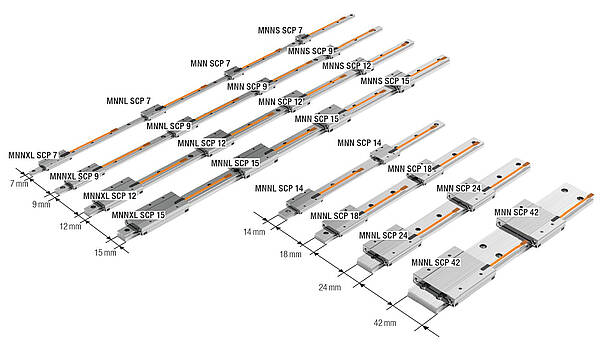
| Types | ||
| Rail width in mm | Carriage | Version |
| MN 7 | MNNS SCP 7 | short |
| MNN SCP 7 | standard | |
| MNNL SCP 7 | long | |
| MNNXL SCP 7 | extra long | |
| MN 9 | MNNS SCP 9 | short |
| MNN SCP 9 | standard | |
| MNNL SCP 9 | long | |
| MNNXL SCP 9 | extra long | |
| MN 12 | MNNS SCP 12 | short |
| MNN SCP 12 | standard | |
| MNNL SCP 12 | long | |
| MNNXL SCP 12 | extra long | |
| MN 15 | MNNS SCP 15 | short |
| MNN SCP 15 | standard | |
| MNNL SCP 15 | long | |
| MNNXL SCP 15 | extra long | |
| MN 14 | MNN SCP 14 | standard |
| MNNL SCP 14 | long | |
| MN 18 | MNN SCP 18 | standard |
| MNNL SCP 18 | long | |
| MN 24 | MNN SCP 24 | standard |
| MNNL SCP 24 | long | |
| MN 42 | MNN SCP 42 | standard |
| MNNL SCP 42 | long | |
| Resolution | 0.1 μm |
| Accuracy | to 1000 mm = +/- 5 μm |
| Repeat accuracy | unidirectional = +/- 0.1 μm bidirectional = +/- 0.2 μm |
| Dimensional scale | pitch 100 μm max. length 1000 mm (the maximum length depends in the width of the respective rail) Coefficient of expansion 11.7 x 10⁻⁶K-1 |
| Rail | width in mm 7, 9, 12, 15 and 14, 18, 24, 42 accuracy classes G1 preload classification V1 max. length 1000 mm (the maximum length depends in the width of the respective rail) |
| Speed | 5 m/s analog 3.2 m/s digital |
| Acceleration | max. 300 m/s² (30 g) |
| Supply voltage | 5 V DC +/- 5 % @70 mA |
| Output signal | Analog: 1 Vpp (at 120 Ω) Digital: TTL in accordance with RS 422 standard |
| Sensor interface | flexible PCB with 9-pin ZIF-connector (0.5 mm grating pitch). Total length 75 mm, permissible bending radius > 2 mm |
| Interface module | Interface module with D-Sub 9 connector |
| RoHS compatible | yes |
| EMV | corresponding to standard EN 61000-6 |
| Environmental influences | operating temperature: -40° to 80° C (-40° to 176° F) storage temperature: -40° to 100° C (-40° to 212° F) humidity: 10 % - 70 % (non-condensing) vacuum: on request clean room: clean room classification ISO 7 or ISO 6 (acc. to ISO 14644-1) elec. charging: ESD-protection required |
| Types | ||
| Rail width in mm | Carriage | Version |
| MN 7 | MNNS SCP 7 | short |
| MNN SCP 7 | standard | |
| MNNL SCP 7 | long | |
| MNNXL SCP 7 | extra long | |
| MN 9 | MNNS SCP 9 | short |
| MNN SCP 9 | standard | |
| MNNL SCP 9 | long | |
| MNNXL SCP 9 | extra long | |
| MN 12 | MNNS SCP 12 | short |
| MNN SCP 12 | standard | |
| MNNL SCP 12 | long | |
| MNNXL SCP 12 | extra long | |
| MN 15 | MNNS SCP 15 | short |
| MNN SCP 15 | standard | |
| MNNL SCP 15 | long | |
| MNNXL SCP 15 | extra long | |
| MN 14 | MNN SCP 14 | standard |
| MNNL SCP 14 | long | |
| MN 18 | MNN SCP 18 | standard |
| MNNL SCP 18 | long | |
| MN 24 | MNN SCP 24 | standard |
| MNNL SCP 24 | long | |
| MN 42 | MNN SCP 42 | standard |
| MNNL SCP 42 | long | |
| Resolution | 0.1 μm |
| Accuracy | to 1000 mm = +/- 5 μm |
| Repeat accuracy | unidirectional = +/- 0.1 μm bidirectional = +/- 0.2 μm |
| Dimensional scale | pitch 100 μm max. length 1000 mm (the maximum length depends in the width of the respective rail) Coefficient of expansion 11.7 x 10⁻⁶K-1 |
| Rail | width in mm 7, 9, 12, 15 and 14, 18, 24, 42 accuracy classes G1 preload classification V1 max. length 1000 mm (the maximum length depends in the width of the respective rail) |
| Speed | 5 m/s analog 3.2 m/s digital |
| Acceleration | max. 300 m/s² (30 g) |
| Supply voltage | 5 V DC +/- 5 % @70 mA |
| Output signal | Analog: 1 Vpp (at 120 Ω) Digital: TTL in accordance with RS 422 standard |
| Sensor interface | flexible PCB with 9-pin ZIF-connector (0.5 mm grating pitch). Total length 75 mm, permissible bending radius > 2 mm |
| Interface module | Interface module with D-Sub 9 connector |
| RoHS compatible | yes |
| EMV | corresponding to standard EN 61000-6 |
| Environmental influences | operating temperature: -40° to 80° C (-40° to 176° F) storage temperature: -40° to 100° C (-40° to 212° F) humidity: 10 % - 70 % (non-condensing) vacuum: on request clean room: clean room classification ISO 7 or ISO 6 (acc. to ISO 14644-1) elec. charging: ESD-protection required |

Die ausgewählte Grösse kann konfiguriert werden und steht in allen gängigen Datenformaten zur Verfügung
Bitte klicken Sie auf die entsprechende Grössenkombination um den Download zu starten.


MINISCALE PLUS is ideal for applications where space is limited and a high precision and process security is required.
The MINISCALE PLUS system has the advantage that the measuring sensor is directly integrated into the carriage, eliminating the need for additional installation space. A separate length measuring system is not required, which significantly reduces design effort. Additionally, adjusting the position measuring system is unnecessary, as the system operates as a Plug and Play solution.
Measurement is performed by a scale embedded in the rail surface with a division period of 100 μm. Two LEDs illuminate this structured surface, creating bright and dark fields. The sensor detects these optical signals and converts them into electrical signals, which are then processed in the interface module.
The interface module is required to convert the raw signals provided by the sensor into standardized output signals. Both analog and digital interface modules are available, offered in four different designs.
In an incremental measuring system, a reference mark is used to determine a fixed zero point. This mark is placed on the reference track next to the incremental track and is also detected by the sensor.
The reference marks can be placed in any number and at any position along the reference track, as long as they are synchronized with the scale. The minimum distance between marks is 1.5 mm, and a distance of at least 2 mm should be maintained from the end of the incremental track.
The MINISCALE PLUS system offers a standard resolution of 0.1 μm, with optional resolutions of 1 μm or 10 μm. At a resolution of 0.1 μm, the system guarantees a unidirectional accuracy of ±0.1 μm and a bidirectional accuracy of ±0.2 μm.
The system offers two types of output signals: an analog variant (1 Vpp at 120 Ω) and a digital variant (TTL, compliant with RS 422 standard).
If the interface module cannot be placed directly at the sensor, an extension set can be used. A flexible flat cable (FFC) is used between the sensor and the interface module, available in lengths of 250 mm, 400 mm, or 600 mm. An adapter board is supplied with the extension cable.
MINISCALE PLUS was developed for high speeds and accelerations and is particularly suitable for applications with limited installation space:
Medical and laboratory automation: Pipetting, analysis and diagnostic devices
Semiconductor industry: Bonding systems, inspection systems
Optics and metrology: Focusing units, microscopy stages
Robotics and micro-automation: Pick-and-place applications
The combination of guideway and distance measuring system in a single product saves space in the machine layout and reduces assembly time. Sensor and scale are protected from contamination due to their shielded position. Simply "Plug & Play".
The MINISCALE PLUS system has the advantage that the measuring sensor is directly integrated into the carriage, eliminating the need for additional installation space. A separate length measuring system is not required, which significantly reduces design effort. Additionally, adjusting the position measuring system is unnecessary, as the system operates as a Plug and Play solution.
Measurement is performed by a scale embedded in the rail surface with a division period of 100 μm. Two LEDs illuminate this structured surface, creating bright and dark fields. The sensor detects these optical signals and converts them into electrical signals, which are then processed in the interface module.
The interface module is required to convert the raw signals provided by the sensor into standardized output signals. Both analog and digital interface modules are available, offered in four different designs.
In an incremental measuring system, a reference mark is used to determine a fixed zero point. This mark is placed on the reference track next to the incremental track and is also detected by the sensor.
The reference marks can be placed in any number and at any position along the reference track, as long as they are synchronized with the scale. The minimum distance between marks is 1.5 mm, and a distance of at least 2 mm should be maintained from the end of the incremental track.
The MINISCALE PLUS system offers a standard resolution of 0.1 μm, with optional resolutions of 1 μm or 10 μm. At a resolution of 0.1 μm, the system guarantees a unidirectional accuracy of ±0.1 μm and a bidirectional accuracy of ±0.2 μm.
The system offers two types of output signals: an analog variant (1 Vpp at 120 Ω) and a digital variant (TTL, compliant with RS 422 standard).
If the interface module cannot be placed directly at the sensor, an extension set can be used. A flexible flat cable (FFC) is used between the sensor and the interface module, available in lengths of 250 mm, 400 mm, or 600 mm. An adapter board is supplied with the extension cable.
MINISCALE PLUS was developed for high speeds and accelerations and is particularly suitable for applications with limited installation space:
Medical and laboratory automation: Pipetting, analysis and diagnostic devices
Semiconductor industry: Bonding systems, inspection systems
Optics and metrology: Focusing units, microscopy stages
Robotics and micro-automation: Pick-and-place applications
The combination of guideway and distance measuring system in a single product saves space in the machine layout and reduces assembly time. Sensor and scale are protected from contamination due to their shielded position. Simply "Plug & Play".

This week, we welcomed the Rotary Club Langenthal and numerous partners to our new Plant 3 in Roggwil.
Read article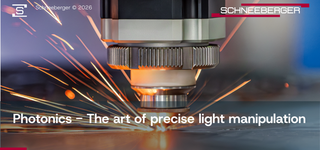
SCHNEEBERGER Sets New Standards in the Photonics Industry
Read article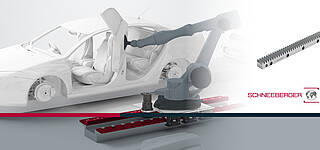
Discover selected SCHNEEBERGER gear racks now available in the e-shop – fast, precise, and ready when you are.
Read article

 USA
USA